


Every CFO knows the feeling: another cloud bill that’s higher than expected, with line items that don’t quite add up. The culprit? Often, it’s not what you’re running—it’s what you’ve forgotten you’re running.
The Hidden Cost of Forgotten Resources
Here’s a scenario playing out in enterprises worldwide: A developer spins up a VM to test a new feature. The test completes, the VM is deleted, and everyone moves on. Mission accomplished, right?
Not quite.
That VM left behind a constellation of resources—persistent disks, network interfaces, IP addresses, snapshots, and security groups. Each one generates charges. Day after day. Month after month. One forgotten disk at $50/month seems trivial. A thousand of them? That’s $600,000 annually walking out the door.
This isn’t negligence. It’s the nature of modern cloud infrastructure. The very flexibility that makes cloud computing powerful—the ability to rapidly provision and scale—creates an environment where orphaned resources accumulate like digital sediment.
Why Traditional Approaches Fall Short
Most organizations rely on one of three strategies, all fundamentally flawed:
- Manual audits: Teams periodically review resources and clean up what they find. This approach suffers from the same problem it’s trying to solve—human error, delayed analysis and actions. Research shows that each additional human touchpoint in a process increases the error rate significantly. Manual processes don’t scale, can’t keep pace with cloud-native development, and pull engineers away from value-creating work.
- Rigid automation: Simple scripts that delete resources based on tags or age. These tools are blunt instruments—they either miss edge cases or delete critical resources, creating a different kind of crisis.
- Dashboard fatigue: Reporting tools that surface potential waste but require human interpretation and action. The problem isn’t visibility—it’s the cognitive load required to turn visibility into action.
Enter Agentic AI: From Observation to Orchestration
This is where Andromeda fundamentally reimagines cloud operations. Rather than building another monitoring tool, we’ve built an agentic AI platform—a system where specialized AI agents don’t just identify problems but orchestrate their resolution.
At the heart of Andromeda is Agent Sherlock, the intelligent orchestrator that serves as the single entry point for all cloud optimization activities. But Sherlock isn’t a monolithic AI trying to do everything. It’s a conductor leading an ensemble of specialized agents, each designed for specific tasks.
How Autonomous Disk Cleanup Actually Works
Let me walk you through a real workflow—one that’s running in production environments today: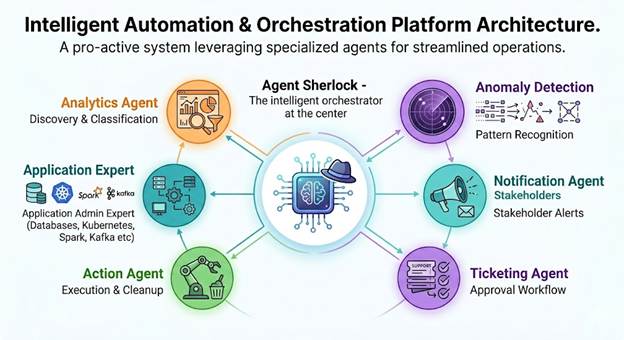
Figure 1: Sherlock orchestrates specialized AI agents to create an autonomous cloud optimization workflow
- Intelligent Wake-Up:Sherlock activates on a schedule—daily for high-velocity environments, weekly for stable production, or triggered by specific events like budget thresholds. These are just examples, essentially it can mimic human behavior of analysis at certain schedule or event driven efforts based on higher priority alerts or notifications.
- Comprehensive Discovery: Sherlock deploys specialized discovery agents that build a complete inventory across your multi-cloud estate. These agents understand the relationships between resources—they know that a disk was attached to a VM that no longer exists, that a network interface belongs to a deleted instance, that a snapshot has outlived its parent volume.
- Context-Aware Classification: Not all idle resources are waste. An agent analyzes usage patterns, metadata, and business context to classify resources:
- Zombie resources: Attached to deleted infrastructure with no recovery path
- Temporarily idle: Part of legitimate test/dev cycles
- Savings candidates: Running continuously but rarely used
- Protected assets: Disaster recovery, compliance holds, or strategic reserves
- Stakeholder Engagement:Here’s where it gets interesting. Sherlock doesn’t just generate a PDF report. It:
- Creates detailed, resource-specific reports for account owners
- Files Jira tickets with full context and recommended actions
- Sends notifications through your existing channels—email, Slack, Google Chat, or MS Teams
- Provides a one-click approval mechanism for resource cleanup
- Execution and Verification Once approved (or automatically, if you’ve enabled auto-remediation for specific resource types), cleanup agents execute the deletions, verify completion, and conduct a post-action inventory to confirm the expected state.
- Value Documentation Financial reporting agents calculate and document savings—not just projected savings, but actual dollars recovered. This creates the accountability and visibility that finance teams need.
The Compounding Value of Agent Intelligence
What makes this approach transformative isn’t just automation—it’s continuous learning.
Over time, Sherlock’s agents observe patterns: Test environments that predictably spin up Monday morning and shut down Friday evening. Development databases that clone production weekly. ML training workloads that consume resources in bursts.
Armed with this learning, the platform evolves from reactive cleanup to proactive lifecycle management. Test environments become fully autonomous—provisioned when needed, decommissioned when idle, with human involvement limited to exception handling and periodic review.
The engineer who used to spend Friday afternoons cleaning up the week’s test infrastructure? They’re now designing the next generation of your product.
From Waste Management to Strategic Capability
Here’s the leadership insight: This isn’t really about disk cleanup. It’s about establishing a self-healing and self-tuning cloud infrastructure that aligns resource consumption with business value in real-time.
The same agentic architecture can accomodate:
- Right-sizing compute instances based on actual usage patterns
- Optimizing data transfer costs across regions
- Managing SaaS license allocation dynamically
- Enforcing governance policies without creating bottlenecks
- Database, Analytics (DataBricks/Snowflake), LLM Optimization
Each agent in the Andromeda “jukebox” adds new capabilities without adding operational complexity. The cognitive load on your teams stays constant or decreases.
The Path Forward
The question for technology leaders isn’t whether AI will transform cloud operations—it’s whether you’ll lead that transformation or react to it.
Organizations implementing agentic AI platforms are seeing
- 50-70% reduction in cloud waste within the first quarter
- 10-15 hours per engineer per week reclaimed from operational toil
- 30-40% faster incident response through automated triage and remediation
- Measurable improvement in cloud governance compliance
More importantly, they’re building organizational muscle around AI-augmented operations—preparing their teams for an environment where human expertise is amplified by intelligent agents, not replaced by them.