
Most enterprises invest heavily in cloud adoption. They plan migrations, train teams, modernize applications, and optimize for speed. What they consistently underinvest in is governance , the operational framework that determines whether cloud spend stays purposeful, accountable, and aligned with business objectives over time.
The result is predictable. Cloud budgets balloon past forecasts. Finance teams struggle to allocate costs accurately across business units. Engineering teams provision resources without consistent tagging, making spend attribution a manual, error-prone exercise. By the time leadership notices, the problem has compounded across dozens of accounts, hundreds of services, and multiple cloud providers.
Cloud governance isn’t a constraint on cloud adoption. It’s what makes cloud adoption sustainable. This guide breaks down exactly what a governance framework looks like, what it needs to include, and how to implement it without slowing down the teams that depend on the cloud to move fast.
What Is a Cloud Governance Platform?
A cloud governance platform is a centralized system that enforces financial, operational, and policy controls across an organization’s cloud environment. It sits above the native tools offered by AWS, Azure, GCP, OCI, Huawei Cloud, and VMware, providing unified visibility and control that spans providers, accounts, and business units.
At its core, a cloud governance platform answers three questions that no individual cloud provider console can answer on its own:
- Where is cloud spend going, and who is responsible for it?
- Are teams operating within approved budgets and policies?
- Is the environment structured in a way that makes cost attribution accurate and auditable?
The distinction between a governance platform and a basic cost monitoring tool matters. Cost monitoring tells you what happened. Governance determines what is allowed to happen, establishes accountability before spend occurs, and enforces compliance continuously rather than after the fact.
For mid-to-large enterprises, governance platforms are no longer optional infrastructure. They are a prerequisite for operating Cloud at scale with financial confidence.
The 3 Pillars of Cloud Governance
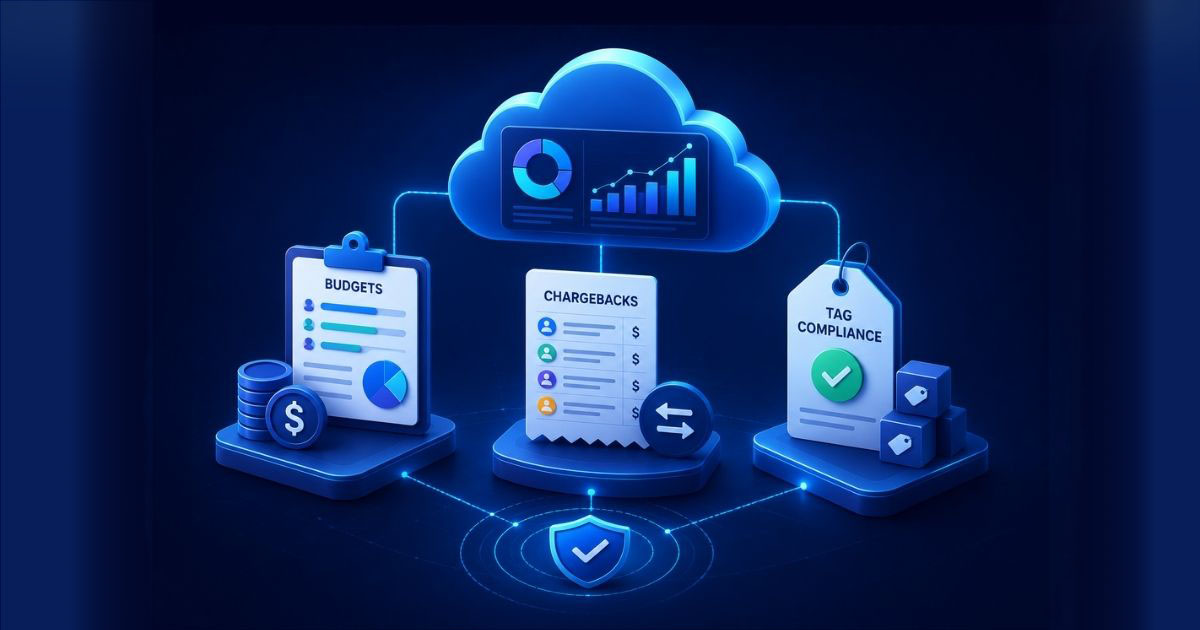
Effective cloud governance rests on three interconnected pillars. Each addresses a different failure mode that emerges as cloud environments grow in complexity.
Pillar 1: Cloud Budget Management
Cloud budget management is the practice of defining, distributing, monitoring, and enforcing spending limits across teams, projects, environments, and accounts. It moves financial accountability from a centralized finance function into the hands of the teams generating spend, with guardrails that prevent overruns from becoming billing surprises.
Effective cloud budget management operates at multiple levels simultaneously. At the enterprise level, there is a total cloud spend ceiling aligned with the annual operating plan. Below that, budgets cascade to business units, then to individual teams or projects, and in mature organizations, down to specific workloads or environments. This hierarchical structure ensures that every dollar of cloud spend has an owner and a limit.
The operational mechanics matter as much as the structure. Budget alerts should trigger at meaningful thresholds (50%, 75%, 90%, 100% of allocated spend) with sufficient lead time for teams to take corrective action. Forecasts based on current consumption trends should be available in real time, not just at month-end. And budget exceptions, when legitimate, should follow a documented approval process rather than being handled informally.
What separates mature cloud budget management from basic threshold alerts is forecasting intelligence. Organizations that can project end-of-month spend based on current burn rates, seasonal patterns, and planned deployments can intervene proactively rather than reactively. A team that sees a credible forecast showing 130% budget utilization by month-end has time to act. A team that discovers the overage on the 1st of the following month does not.
Pillar 2: Cloud Chargeback and Showback
One of the most persistent governance challenges in enterprise cloud environments is cost allocation: determining which business unit, product line, or team is responsible for which portion of the cloud bill, and holding them accountable for it.
Cloud chargeback and showback are two approaches to this problem, and they serve different organizational contexts.
Showback is the practice of providing teams with visibility into their cloud consumption and its associated cost, without formally billing them for it. It builds cost awareness and accountability without requiring the accounting infrastructure needed to move actual dollars between internal cost centers. For organizations early in their FinOps maturity, showback is a practical starting point that drives behavioral change before formal chargeback is implemented.
Chargeback takes the next step: actual internal billing, where each business unit is formally charged for the cloud resources it consumes. This model creates the strongest financial accountability because teams are directly responsible for their spend in their own P&L. It also provides finance with the granular cost data needed for accurate product-level profitability analysis and customer billing in businesses where cloud costs flow through to clients.
The technical challenge in both models is shared costs. Not all cloud spend can be attributed directly to a single team or project. Networking infrastructure, shared data platforms, security tooling, and centrally managed services generate costs that benefit multiple stakeholders. A mature governance framework defines explicit allocation methodologies for shared costs: proportional split based on usage metrics, fixed percentage allocation, or direct assignment based on a cost center hierarchy. These methodologies need to be documented, consistently applied, and auditable.
Pillar 3: Tag Compliance
Tagging is the foundation of cloud cost attribution. Without consistent, accurate tags applied to every cloud resource, cost allocation devolves into estimation and guesswork. With strong tagging governance, every compute instance, storage bucket, database, and network component is traceable to an owner, a project, an environment, and a cost center.
Tag compliance governance encompasses three distinct challenges:
Tag strategy definition. Before enforcement is possible, the organization must define a canonical tag taxonomy. This typically includes a mandatory set of tags (environment, team, project, cost-center, application) and an optional set for more granular tracking. Tag keys and value formats must be standardized. “Production,” “prod,” and “PRD” all mean the same thing to an engineer, but they generate three separate cost categories in any reporting system that doesn’t normalize them.
Tag enforcement at provisioning. The most effective governance programs prevent untagged resources from being created in the first place. This is achieved through infrastructure-as-code policies (using tools like AWS Service Control Policies, Azure Policy, or GCP Organization Policies) that reject provisioning requests that don’t include required tags. Enforcement at the point of creation eliminates the ongoing remediation burden that accumulates when tagging is treated as a post-provisioning cleanup exercise.
Tag compliance monitoring and remediation. Even with enforcement policies in place, tag drift occurs. Resources get modified, tags get removed, legacy infrastructure predates the tagging policy. Continuous monitoring of tag compliance rates, automated alerts when coverage falls below acceptable thresholds, and clear ownership of remediation workflows are essential components of a sustained governance program.
How Enterprises Enforce Governance Without Slowing Down Teams
The most common objection to cloud governance programs is that they add friction to engineering workflows. This concern is valid when governance is implemented as a bureaucratic approval layer rather than as an intelligent guardrail.
The distinction matters. A governance framework that requires a five-day approval to spin up a development instance will be circumvented the moment it creates a deployment bottleneck. A governance framework that auto-approves provisioning requests that comply with policy, routes exceptions to the appropriate approver with full context, and enforces tags at the infrastructure layer rather than through manual review adds accountability without adding delay.
Practical principles for governance that scales without friction:
- Policy as code, not process. Enforce tagging, budget, and resource type policies through infrastructure tooling rather than manual review. Automation is faster than any human approval chain and more consistent.
- Self-service within guardrails. Teams should be able to provision what they need within their approved budget and compliance parameters without waiting for central IT. Governance defines the playing field; it doesn’t call every play.
- Visibility before accountability. Introducing chargeback before teams have had time to understand and optimize their spend creates resentment rather than responsibility. Showback first, chargeback later is a sequencing principle that improves adoption.
- Escalation paths, not hard blocks. For legitimate exceptions, governance frameworks need clear escalation paths with documented justification requirements. Hard blocks with no path forward force workarounds.
- Regular governance reviews. Policies set 18 months ago may not reflect the current architecture or organizational structure. Governance frameworks need scheduled reviews to stay relevant and effective.
Building a Cloud Governance Framework Step by Step
Implementing governance at scale is a program, not a project. The following sequence reflects how mature organizations build governance capabilities progressively rather than attempting to implement everything at once.
Step 1: Establish visibility. Before governance, you need data. Centralize cost and usage data across all cloud accounts and providers into a single platform. Identify the current state of tagging coverage, budget overruns, and unallocated spend.
Step 2: Define your tag taxonomy. Work with finance, engineering, and operations to agree on mandatory tags, value formats, and the resource types they apply to. Document the taxonomy and communicate it before enforcement begins.
Step 3: Implement showback. Build initial cost allocation reports by business unit and team based on available tagging data. Share them with stakeholders. The act of making costs visible changes behavior before any policy is enforced.
Step 4: Enforce tagging at provisioning. Implement infrastructure policies that require mandatory tags at the point of resource creation. Establish a remediation process for legacy untagged resources with clear ownership and timelines.
Step 5: Build the budget hierarchy. Define enterprise, business unit, and team-level budgets. Configure threshold alerts and real-time forecasting. Assign budget owners and document escalation paths for overruns.
Step 6: Transition to chargeback (where appropriate). Once showback is stable and teams understand their spend, implement formal chargeback for business units with the maturity and accounting infrastructure to support it.
Step 7: Automate governance monitoring. Implement continuous monitoring of tag compliance rates, budget utilization, and policy violations. Regular governance reporting to senior stakeholders keeps the program accountable and visible at the leadership level.
How Aquila Clouds Enables Governance at Scale
Aquila Clouds is built to operationalize every component of a cloud governance framework in a unified platform, without requiring organizations to stitch together multiple point solutions.
Budget management in Aquila Clouds supports hierarchical budget structures that mirror organizational reporting lines, with configurable alert thresholds, real-time burn rate tracking, and AI-driven forecasting that projects end-of-period spend based on current consumption patterns. Finance and engineering leaders see the same data in context that is relevant to their respective roles.
Chargeback and showback capabilities in Aquila Clouds handle both direct cost attribution and shared cost allocation through configurable distribution rules. Organizations can run showback reporting for any time period, apply multiple allocation methodologies simultaneously for different cost categories, and generate chargeback reports formatted for integration with internal billing and ERP systems.
Tag compliance is managed through a dedicated compliance module that tracks tagging coverage across all cloud resources, identifies gaps, surfaces remediation tasks with resource-level detail, and monitors compliance trends over time. Policy enforcement integrations allow Aquila Clouds to work alongside existing infrastructure-as-code tooling to prevent untagged resource creation upstream.
Across all three pillars, Aquila Clouds provides multi-cloud coverage: AWS, Azure, GCP, OCI, Huawei Cloud, and VMware in a single governance layer, with a unified account hierarchy that maps to organizational structures rather than cloud provider account trees.
For enterprises managing cloud at scale, the question is not whether governance is necessary. It is whether the platform supporting that governance is capable of keeping pace with the complexity, velocity, and multi-cloud reality of modern cloud operations.
Governance Is the Foundation, Not the Ceiling
Cloud governance done well doesn’t constrain what organizations can do with the cloud. It creates the financial clarity, operational accountability, and policy consistency that allow cloud adoption to accelerate with confidence rather than anxiety.
Budget management, chargeback and showback, and tag compliance are not administrative overhead. They are the infrastructure of a cloud program that finance can trust, engineering can operate within, and leadership can explain to the board.
Take control of your cloud governance. See Andromeda in action.